President's Letter, 2025/26 Annual Report:
The past year has been a sobering one for us as an organization. Once again, our daily food program surpassed last year's records, setting new highs for both single-day and annual meals served—a testament to the dedication and output of our staff, but above all an indication of the immense and growing need within our community. We served more than 85,000 meals in 2025/26, an increase of 17 per cent over the previous year. Demand for our services has grown every year that we have tracked it, for more than 20 years.
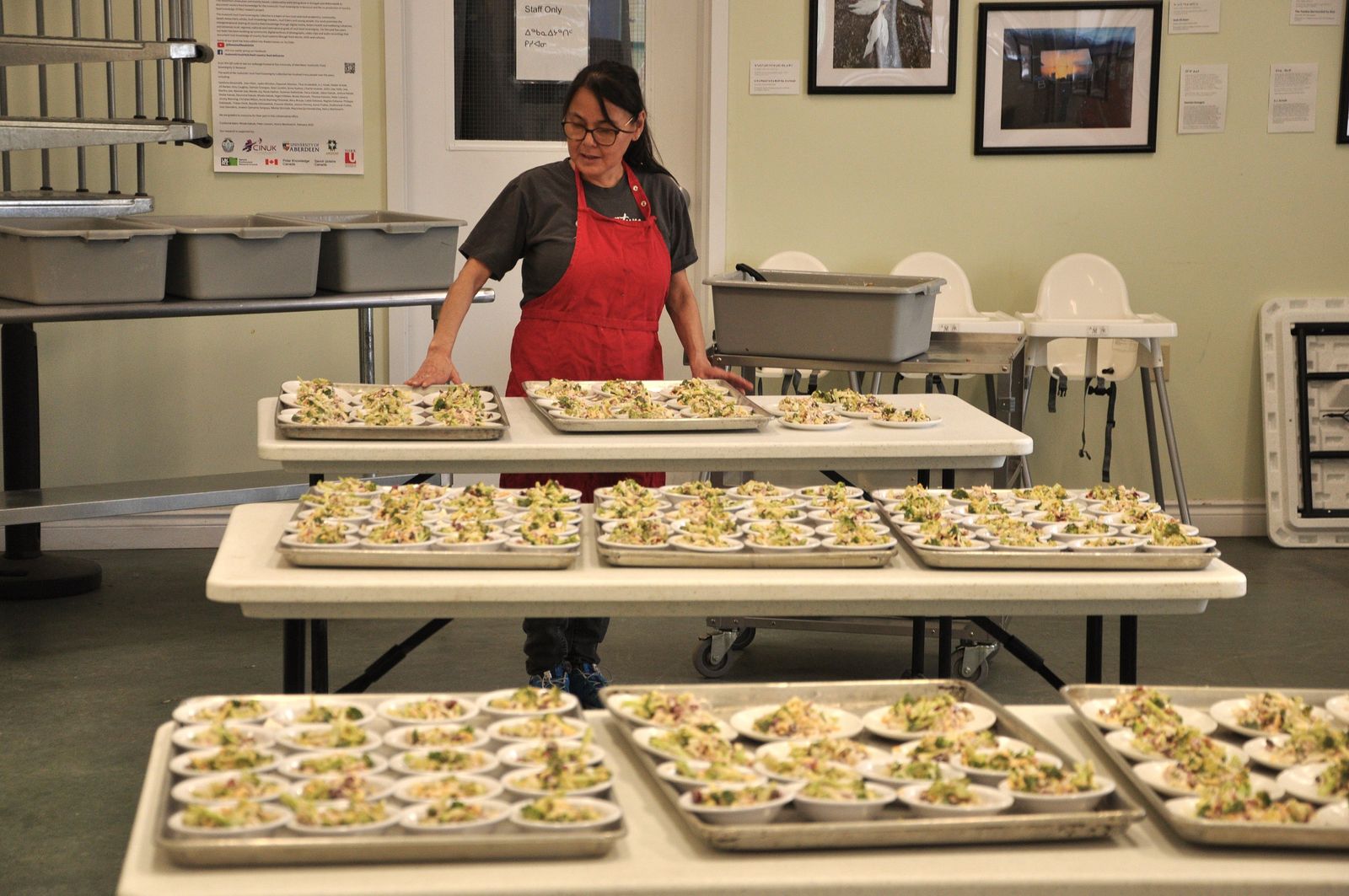
Every day at the Food Centre we see the very human, unfiltered reality of food insecurity in Iqaluit. Community members from every walk of life fill our dining hall Monday to Friday, including many you would never expect to find relying on a community food program. In a single day last September, we served 639 meals—equivalent to 7.4 per cent of the city's population. That would be proportional to producing roughly 240,000 meals in Toronto, 141,000 in Montreal, or 83,000 in Ottawa in a single day. The need in Iqaluit is greater than many people realize, and the demand far exceeds what our small but mighty team can currently provide.
One day last fall, I fell into a brief state of despair, unable to bring myself to leave the house or even cook a meal. A friend brought me food from the Food Centre: a simple meal of roast chicken, rice, and vegetables. When I opened the container, I was overwhelmed with gratitude. It was such a beautiful expression of care and love to receive such a meal. I broke down crying.
In that moment, I felt immense pride in our team. Every day, they prepare hundreds of meals for members of our community. If those meals give someone even a small measure of the comfort and care I felt that day, then they are doing something truly extraordinary. Feeding one another is among the most fundamental expressions of love and care we have as human beings.
The next day I returned to the Food Centre and ate a beautiful bowl of muskox stew. I remember thinking: this is what we do—we care for one another through food. I thought that not as the Executive Director, but simply as someone using the services we provide.
If we can prepare 639 meals in a single day with the team and facilities we have today, imagine what could be possible with the people, space, and resources to match the need. We know it is possible. As an organization, we are uniquely positioned and experienced to make that vision a reality. With the right support, we can ensure that everyone in our community has dignified access to nutritious food every day. In a country as prosperous as Canada, that should be an achievable goal. And if we know we can meet that need, then it is a moral imperative that we do so.
Of course, we cannot accomplish that alone. Meeting a challenge of this scale requires committed partners who share our belief that access to food is a basic human right. Right to Food, our national partner, provides the guiding principles that shape every one of our programs and ensure that everyone who enters our space is treated with dignity. The support of our funders recognizes the impact of this work, demonstrates confidence in our organization, and acknowledges both the scale and urgency of the need.
And so we look to the future with hope. We envision a future where Qajuqturvik Community Food Centre has the people, space, and resources to meet the growing needs of our community—not simply by serving meals, but by caring for one another through food.
Jessie Hale , President, Board of Directors